Showing posts with label Latest Tech Books. Show all posts

Friday, 21 October 2022

AWS Certified SAA-C03 Exam Preparation Guide

AWS Study Guide
AWS Certified Solutions Architect Study Guide: Associate (SAA-C03) Exam 4th Edition

A subsidiary of Amazon, Amazon Web Services, Inc. offers government agencies, businesses, and people metered pay-as-you-go cloud computing platforms and APIs. Through AWS server farms, these cloud computing web services offer software tools and distributed computer processing capacity. The most complete and widely used cloud platform in the world, Amazon Web Services (AWS), provides over 200 fully functional services from data centers across the world. Millions of clients use AWS to save costs, increase agility, and accelerate innovation, including the largest corporations, most successful governmental organizations, and the fastest-growing startups. The AWS cloud computing services include Compute, Networking, Storage, Database, Application Management, and Security and Identity. An AWS solutions architect is the person whose job is to look after these service categories. An AWS Solutions Architect designs, builds, deploys, and maintains business applications and critical infrastructure inside the AWS Cloud.

The AWS Certified Solutions Architect Study Guide: Associate (SAA-C03) Exam, 4th Edition comprehensively and effectively prepares you for the challenging SAA-C03 Exam. This Study Guide contains efficient and accurate study tools that will help you succeed on the exam. It offers access to the Sybex online learning environment and test bank, containing hundreds of test questions, bonus practice exams, a glossary of key terms, and electronic flashcards.

In this complete and authoritative exam prep blueprint, you are guided on you how to:

  • Design resilient AWS architectures
  • Create high-performing solutions
  • Craft secure applications and architectures
  • Design inexpensive and cost-optimized architectures

Here is the list of contents covered in this guide:

Introduction to Cloud Computing and AWS

Cloud computing and virtualization
Cloud computing architecture
Cloud computing optimization
The AWS Cloud
AWS platform architecture
AWS reliability and compliance
The AWS shared responsibility model
The AWS service level agreement
AWS organizations
AWS control tower
AWS service catalog
AWS license manager
AWS artifact
The AWS CLI
AWS SDKs
Migrating existing resources to AWS

AWS Compute Services

EC2 instances
EC2 storage volumes
Accessing your EC2 instance
Securing your EC2 instance
EC2 auto scaling
AWS systems manager
Running containers
Amazon elastic container service
Amazon elastic Kubernetes service

AWS Storage

S3 service architecture
S3 durability and availability
S3 object life cycle
Accessing S3
Amazon S3 Glacier
Amazon elastic file system
Amazon FSx
AWS storage gateway
AWS snow family
AWS DataSync

Amazon Virtual Private Cloud (VPC)

VPC CIDR Blocks
Secondary CIDR blocks
IPv6 CIDR blocks
Subnet CIDR blocks
Availability zones
Elastic network interfaces
Primary and secondary private IP addresses
Attaching elastic network interfaces
Enhanced networking
Internet gateways
Route tables
Security groups
Stateful firewall
Default security group
Network access control lists and security
AWS network firewall
AWS global accelerator
Network Address Translation
AWS PrivateLink
VPC Peering
Hybrid cloud networking
AWS site-to-site VPN
AWS transit gateway
AWS direct connect 
High-performance computing
Elastic fabric adapter
AWS parallel cluster

Database Services

Relational databases
Columns and attributes
Structured Query Language
OLTP and OLAP
Amazon relational database service
Amazon Redshift
Norelational (NoSQL) databases
DynamoDB

Authentication and Authorization - AWS Identify and Access Management

IAM Identities
Authentication tools
Amazon Cognito
AWS managed Microsoft AD
AWS single sign-on
AWS key management service
AWS secret manager
AWS cloudHSM
AWS Resource Access Manager

CloudTrail

Management events
Data events
Event History
Trails
Log file integrity validation

CloudWatch

CloudWatch metrics
Graphing metrics
Metric math
CloudWatch logs
CloudWatch alarms
Amazon EventBridge

AWS Config

The Configuration Recorder
Configuration items
Configuration history
Configuration snapshots

The Domain Name System and Network Routing

Amazon Route 53 
Amazon CloudFront

Data Ingestion, Transformation, and Analytics

AWS Lake Formation
AWS Transfer Family
Kinesis video streams
Kinesis data streams
Kinesis data firehose

Resilient Architectures

Availability differences in traditional vs. cloud-native applications
EC2 auto scaling
Data Backup and Recovery
Creating a resilient network
Simple queue service

High-Performance Architectures

Optimizing performance for the core AWS service
Infrastructure automation
Reviewing and optimizing infrastructure configurations
Optimizing data operations (cashing, partitioning/sharding, and compression)

Secure Architectures

Identity and access management
Protecting AWS credentials
Fine-grained authorization
Roles
Enforcing service-level protection
Detective controls
Searching logs with Athena
Auditing resource configurations with AWS config
Amazon GuardDuty
Amazon Inspector
Amazon Detective
Security Hub
Amazon fraud detector
AWS audit manager
Protecting network boundaries
Network access control lists and security groups
AWS web application firewall
AWS Shield
AWS Firewall Manager
Data encryption
Data at Rest
Data in Transit
Macie

Cost-Optimized Architectures

Planning, tracking, and controlling costs
AWS budgets
Monitoring tools
AWS trusted advisor
Online calculator tools
Cost-optimizing compute
Maximizing server density
EC2 reserved instances
EC2 spot instances
Auto Scaling
Elastic block store lifecycle manager

Additional Services

AWS Amplify
AWS Serverless Application Repository
AWS Proton
Amazon API Gateway
AWS Device Farm
AWS Step Functions
AWS Outposts
AWS Wavelength
VMware Cloud on AWS
Amazon Pinpoint
AWS Transfer Family
AWS AppSync
Amazon DocumentDB
Amazon Keyspaces
Amazon Quantum Ledger Database
Amazon Managed Streaming for Apache Kafka
Amazon MQ
AWS Data Exchange
Amazon AppFlow
Machine Learning and Artificial Intelligence
Amazon Comprehend
Amazon Forecast
Amazon Lex
Amazon Polly
Amazon Recognition
Amazon Textract
Amazon Transcribe
Amazon Translate
AWS Batch
AWS X-Ray
Amazon Kendra
Amazon OpenSearch Service
Amazon Managed Grafana
Amazon Managed Service for Prometheus


 

Thursday, 20 October 2022

Best Data Analysis Book

Python Data Analysis Book
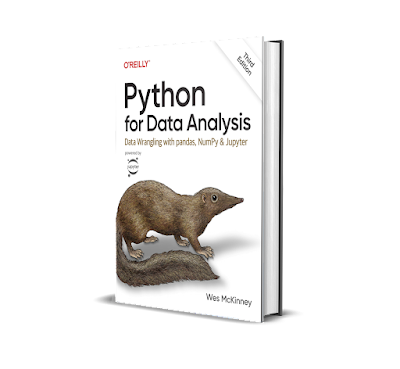
Python for Data Analysis: Data Wrangling with pandas, NumPy, and Jupyter 3rd Edition

The objective of this book is to teach you what data analysis is and how to manipulate, process, clean, and crunch data in Python and data analysis tools. In order to become an effective data analyst, this book acts as a guide to the parts of the Python programming language and its data-oriented library ecosystem and tools. The book focuses on Python programming, libraries, and tools that you need for data analysis. The Python open-source ecosystem for doing data analysis (or data science) has evolved over the years and it has developed a large and active scientific computing and data analysis community. Python has now become one of the most important languages for data science, machine learning, and general software development. In recent years, Python's improved open-source pandas and scikit-learn libraries have made it a popular choice for data analysis tasks. Here is a summarized list of topics covered in this book:

  • Use the Jupyter notebook and IPython shell for exploratory computing
  • Learn basic and advanced features in NumPy
  • Get started with data analysis tools in the pandas library
  • Use flexible tools to load, clean, transform, merge, and reshape data
  • Create informative visualizations with matplotlib
  • Apply the pandas groupby facility to slice, dice, and summarize datasets
  • Analyze and manipulate regular and irregular time series data
  • Learn how to solve real-world data analysis problems with thorough, detailed examples

Here are the details of the topics covered in this book:

Why Python for Data Analysis?

Python Libraries (NumPy, pandas, matplotlib, IPython and Jupyter, SciPy, scikit-learn statsmodels)
Installation (Miniconda on Windows, GNU/Linux, Miniconda on macOS)

Python Language Basics, IPython, and Jupyter Notebook 

 Language Semantics
 Scalar Types
 Control Flow

Data Structures and Sequences 

Tuple
List
Dictionary
Set
Built-In Sequence Functions
List, Set, and Dictionary Comprehensions

Functions

Namespaces, Scope, and Local Functions
Returning Multiple Values
Functions Are Objects
Anonymous (Lambda) Functions
Generators
Errors and Exception Handling
        Bytes and Unicode with Files

NumPy Basics: Arrays and Vectorized Computation

Create ndarray: A multidimensional array object
Data types of ndarrays
Arithmeic with NumPy arrays
Basic indexing and slicing
Boolean indexing
Fancy indexing
Transposing arrays and swapping axes
Pseudorandom number generation
Universal functions: Fast element-wise array functions
Array-Oriented programming with arrays
Expressing conditional logic as array operations
Mathematical and statistical methods
Methods for boolean arrays
        Sorting
Unique and other set logic
File input and output with arrays
Linear algebra

Introduction to pandas data structures

Series
Data Frame
Index Objects
Reindexing
Dropping entries from an Axis
Indexing, Selection, and Filtering
Arithmetic and data alignment
Function application and mapping
Sorting and ranking
Axis indexes with duplicate labels
Correlation and covariance
Unique values, value counts, and membership

Data Loading, Storage, and File Formats

Reading and writing data in text format
Reading text files in pieces
Writing data to text format
working with other delimited formats
JSON data
XML and HTML web scraping
Binary data formats
Reading Microsoft Excel files
Using HDF5 format
Interacting with Web APIs
Interacting with databases

Data Cleaning and Preparation

Handling missing data
Filtering out missing data
Filling in missing data
Data Transformation
Removing duplicates
Transforming data using a function or mapping
Replacing values
Renaming axis indexes
Discretization and binning
Detecting and filtering outliers
Permutation and random sampling
Computing indicator/dummy variables
Extension data types
String manipulation
Python built-in string object methods
Regular expressions
String functions in pandas
Categorical data
Background and motivation
Categorical extension type in pandas
Computations with categoricals
Categorical methods

Data Wrangling: Join, Combine, and Reshape

Hierarchical indexing
Reordering and sorting levels
Summary statistics by level
Indexing with a DataFrame's columns
Combining and merging datasets
Database-style DataFrame joins
Merging on index
Concatenating along an axis
Combining data with overlap
Reshaping and pivoting
Reshaping with Hierarchical indexing
Pivoting "Long" to "Wide" format
Pivoting "Wide" to "Long" format

Plogging and Visualization

Matplotlib API primer
Figures and subplots
Colors, markers, and line styles
Ticks, labels, and legends
Annotations and drawings on a subplot
Saving plots to file
matplotlib configuration
Plotting with pandas and seaborn
Line plots
Bar plots
Histograms and density plots
Scatter or Point plots
Facet grids and categorical data
Other Python visualization tools

Data Aggregation and Group Operations

How to think about group operations
Iterating over groups
Selecting a column or subset of columns
Grouping with dictionaries and series
Grouping with functions
Grouping by index levels
Column-wise and multiple-function application
Returning aggregated data without row indexes
General split-apply-combine
Suppressing the group keys
Quantile and bucket analysis
Example: Filling missing values with group-specific values
Example: Random sampling and permutation
Example: Group weighted average and correlation
Example: Group-wise linear regression
Group transforms and "Unwrapped" groupbys
Pivot tables and corss-tabulation
Cross-tabulations: Crosstab

Time Series

Data and time data types and tools
Converting between string and datetime
Time series basics
Indexing, selectin, subsetting
Time series with duplicate indices
Date ranges, frequencies, and shifting
Generating date ranges
Frequencies and date offsets
Shifting (leading and lagging) data
Time zone handling
Time zone localization and conversion
Operations with time zone-aware timestamp objects
Operations between different time zones
Periods and Period arithmetic
Period frequency conversion
Quarterly period frequencies
Converting timestamps to periods (and back)
Creating a PeriodIndex from arrays
Resampling and frequency conversion
Downsampling
Upsampling and interpolation
Resampling with periods
Grouped time resampling
Moving window functions
Exponentially weighted functions
Binary moving window functions
User-defined moving window functions

Modeling Libraries in Python

Interfacing between pandas and model code
Creating model descriptions with Patsy
Data transformations in Patsy formulas
Categorical data and Patsy
Introduction to statsmodels
Estimating linear models
Estimating time series processes
Introduction to scikit-learn

Data Analysis Examples

Counting time zones in Pure Python
Counting Time Zones with pandas
Measuring rating disagreement
Analyzing naming trends
Donation statistics by occupation and employer
Bucketing donations amounts
Donation statistics by state

Advanced NumPy

ndarray object internals
NumPy data type hierarchy
Advanced array manipulation
Reshaping arrays
C versus Fortran Order
Concatenating and splitting arrays
Repeating elements: tile and repeat
Fancy indexing equivalens: take and put
Broadcasting over other axes
Setting array values by broadcasting
Advanced ufunc usage
ufunc instance methods
Writing new ufuncs in Python
Structured and record arrays
Nested data types and multidimensional fields
Why use structured arrays?
Indirect sorts: argsort and lexsort
Alternative sort algorithms
Partially sorting arrays
numpy.searchsorted: Finding elements in a sorted array
Writing fast NumPy functions with Numba
Creating custom numpy.ufunc objects with Numba
Advanced array input and output
Memory-mapped files
HDF5 and other array storage options
The importance of Contiguous memory

IPython System

Terminal keyboard shortcuts
Magic commands
The %run command
Executing code from the clipboard
Searching and reusing the command history
Input and output variables
Interacting with the operating system
Shell command and aliases
Directory bookmark system
Software development tools
Interactive debugger
Timing Code: %time and %timeit
Basic profiling: %prun and %run -p
Profiling and function line by line
Tips for productive code development using IPython
Reloading module dependencies
Code design tips
Advanced IPython features
Profiles and configuration


Saturday, 8 October 2022

Blockchain Explained In Plain English For Beginners

We live in the centralized Web 2.0 era, in which large amounts of web data and content are centrally stored on the servers of a small group of companies such as Google, Microsoft, Facebook, Amazon, and Apple. The vision of Web 3.0 is to decentralize the internet to make you the owner of your data and content. The objective of this book is to provide you with conceptual and hands-on exposure to Web 3.0 and its related technologies, such as blockchain, cryptocurrencies, decentralized applications, and more. 

The book has two projects that are the essence of this book. The first one, "Health Insurance Claim," demonstrates the creation of a decentralized application (dApp) for the public blockchain using ethers (ETH). You can apply the techniques used in this project to create NFT and other similar projects. The second one is a Hyperledger Fabric project that demonstrates how to create applications for private blockchains that don't involve cryptocurrencies. After reading this book and completing the two projects, not only will you have the conceptual knowledge of Web 3.0, but you will also have a solid foundation to build blockchain applications to enhance your skills even further.

The following list provides the topics covered in this book:

Background of Blockchain and Cryptocurrencies

Here are the topics covered in this section, which starts with the history of money and unveils the scenario that led to the evolution of cryptocurrencies, blockchain, and ultimately Web3. 
  • History of money and background of cryptocurrencies
  • Bitcoin and altcoins
  • Centralized, decentralized, and distributed networks
  • Web 1.0, Web 2.0, and Web 3.0
  • Introduction and history of blockchain
  • Blockchain vs. regular database
  • Public vs. private blockchain
  • Features of blockchain technology
  • How does blockchain work?
  • Blockchain architectural elements
  • Cryptography and hashing
  • Mining process overview
  • Consensus protocol
  • Proof of Work (PoW) & Proof of Stake (PoS)
  • Target hash and mining difficulty
  • Nonce and cryptographic puzzle
  • Mining reward, Bitcoin halving, and transaction fee
  • Cryptocurrencies wallet
  • Public and private keys

Learn Solidity Language

Start your Solidity language exploration journey with Remix IDE. To step into the exciting world of Smart Contract development, it is recommended that beginners start their exploration journey with Remix. The Remix IDE is a powerful, open-source tool that helps you write Solidity contracts straight from the browser. Written in JavaScript, Remix supports both usage in the browser and locally. Remix also supports testing, debugging, deploying smart contracts, and much more. Remix is used for the entire journey of contract development as well as being a playground for learning and teaching Ethereum. 
  • State and local variables in Solidity language
  • View and pure
  • Constructor
  • Arrays (dynamic sized and byte array)
  • For, While, and Do-While loops
  • IF condition
  • Struct
  • Mapping
  • Storage vs. Memory
  • Payable - send and receive funds
  • Visibility
  • Inheritance

Public Blockchain - Ethereum

After grasping the basics of Solidity, you are taken to the next level where you create a small project to apply the skills you learned in the Solidity language section. You create a healthcare insurance dApp (decentralized application) project in which patients upload their claims to the blockchain for quick settlements in ethers (ETH - the currency used on the Ethereum platform). The project is created with the help of Hardhat and React. Hardhat is an Ethereum development environment. It helps you compile your smart contracts and run them on a development network. React is a free and open-source front-end JavaScript library for building user interfaces based on UI components. 
  • Project installation procedure
  • Run Hardhat Network
  • Install MetaMask
  • Set up IPFS gateway to store application images (i.e., patients' medical bills)
  • Deploy smart contract
  • Run and test the application

Private Blockchain - Hyperledger Fabric

Hyperledger's projects include a variety of enterprise-ready permissioned blockchain platforms, where network participants are known to one another and therefore have an intrinsic interest in participating in the consensus-making process. It does not support a cryptocurrency like Bitcoin. Its aim is to provide the necessary infrastructure and standards for developing various blockchain-based systems and applications for industrial use. First, you will learn about the components that make up Hyperledger Fabric. Then, you create a project to manage assets and track the ownership and history of those assets. This project is created using the Hyperledger Fabric test network and its front end is developed in Express JS. Express is a Node.js web application framework that provides broad features for developing web and mobile applications.
  • Hyperledger Fabric components - Assets
  • Shared Ledger
  • Chaincode
  • Channel
  • Organization
  • Nodes
  • Clients
  • Endorsing peer
  • Committing, Anchor, and Leading peers
  • Ordering service (Orderer node)
  • Membership Service Provider and Certificate Authority
  • Hyperledger Fabric network
  • Transaction flow
  • Asset Transfer - Hyperledger Fabric blockchain project
  • Set up the project environment
  • Install Windows Subsystem for Linux (WSL)
  • Fabric Sample Repository & Docker Images
  • Front-end application (Manage assets on the blockchain and track asset history)
  • Glossary


Friday, 3 December 2021

Create Rapid Low-Code Web Applications in Oracle APEX 21.2


Latest Oracle APEX Book

Book's Overview

The format of this book is to teach you about Oracle APEX by iteratively developing the sample sales application from scratch provided with Oracle Application Express.

Each chapter explores a basic area of functionality and the development techniques you will need to achieve that functionality. This application is fully functional and scalable and has been chosen as an example because you can learn most of the techniques you will need for your own future work.

The primary purpose of this book is to teach you how to use Oracle Application Express to realize your own development goals. By the time you reach the end of the examples in this book, you will have a clear understanding of Oracle Application Express and will be able to extend the application in almost any direction.


  WHAT THIS BOOK COVERS

Chapter 1   Oracle Application Express ‐ Introduction
This introductory chapter acquaints you with essential basic concepts about Oracle Application Express. It briefs:

   - What Oracle APEX is?
   - Why migrate conventional desktop applications
      to the exciting world of web
   - Oracle Application Express Architecture
   - Setup Oracle APEX development environment


Chapter 2   Oracle APEX Building Blocks
In this chapter, you will go through the underlying database objects used in the sample application. Besides, you will create the following shared components for your applications:

  
   - Menus
   - Lists
   - Breadcrumbs
   - Navigation Bars
   - Authentication Scheme 
   - Authorization Scheme
   - Security Attribute
   - List of Values (LOVs) and more


Chapter 3   The Home Page
This chapter will walk you through creating the Home page of the sample application. It's a dashboard that appears after a user successfully logs into the application and contains the following regions:
   
   - Sales Quota: Graphically present sales figures in a dial chart against
      the allotted quota for the logged-in user
   - Top Customers: List of top customers with the most orders
   - Top Products: Displays top-selling products
   - Top Orders by Date: Top ordering days
   - List of links to navigate to other application pages


Chapter 4   Manage Customers
You will learn the following techniques in this chapter:
  

   - Add, modify and delete a customer
   - How to create Master/Detail pages
   - Show order details for the selected customers
   - Enable/Disable objects
   - Create validation to prevent customer removal with existing orders
   - Implement customer Credit Limit check
   - All about Interactive Grid


Chapter 5   Setup Products
Similar to Managing Customers, you will be guided on how to add, modify and remove products.
 
Here you will learn how to browse product information using three different angles i.e. Icon, Report, and Detail views. Moreover, you will add a sidebar region to display five best-selling products.

You will also learn how to handle images in Oracle Application Express. The use of dynamic and static LOVs is also covered in this chapter to store legitimate data in tables.


Chapter 6   Place Orders
This chapter will teach you how to create professional-looking order forms. Orders from customers will be taken through a sequence of forms (wizard). The first form will allow the user to select an existing customer or create a new one. In the second step, the user will select products to order and the last step will show a summary of the placed order. Once an order is created, you can view, modify, and delete it through the Order Details page using the edit icon on the orders’ main page. A couple of other pages will be created as well to create a new customer, if one does not exist, and to display product information such as Description, Category, and Price. You will learn the following Oracle APEX features in this chapter:

   - Utilization of wizard using Order Progress list
   - Master/detail forms
   - Primary and Alternative reports
   - Public Reports
   - Report, Chart, and Group by views of data
   - Use of Control Break, Highlight, and Aggregate functions
   - Drill down to the data entry page from the report
   - Graphical presentation of data
   - Add Processes in Page Rendering
   - Create a new customer without leaving the order page
   - Utilize Dynamic Actions to Show/Hide page item
   - How to use the style on pages
   - Usage of PL/SQL code on pages
   - Call a popup window to display information
   - Summarize data presentation


Chapter 7   Generate Graphical Reports

Reports are the most significant components of any application that allows you to extract information from the raw data to make decisions. This chapter not only demonstrates the power of Oracle Application Express to graphically present the information but also exhibits how to drill down to a deeper level to obtain detailed information. You'll learn:
   
   - Page zero creation and utilization
   - Graphical presentation of data
   - Use of different types of charts
   - Drill down from charts to browse details
   - Usage of map and tree views


Chapter 8   Advanced Reporting

Complex printing is the essence of modern applications. The introduction of a print server in Oracle APEX provides a path to create any kind of report to monitor your business activities in real-time. This chapter provides you the following essential hands-on tutorials to fulfill your reporting needs:


- Download, install and use Oracle BI Publisher as your print server
- Configure APEX to use BI Publisher as a print server
- How to enable networking services
- Install BI Publisher Desktop and create report templates in MS Word
- Create a PDF version of an interactive report
- Use Pivot Tables
- Create a Commercial Invoice


Chapter 9   Users Management
In this chapter, you will implement a custom authentication scheme and will create two pages under the
Administration tab to manage users. These two pages will be displayed only to the users with admin privileges. Following are the skills that you will learn in this chapter:
 
- Implement a custom authentication scheme
- Add and Remove users and change their Passwords
- Apply Products authorization scheme through the database
- Usage of Tabular Form
- Hiding tab from unauthorized users
- Add a feedback page to the application


Chapter 10   Deploy and Access Oracle APEX Application
Oracle APEX application deployment consists of two steps. Export the desired components to a script file, and import the script file into your production environment.
This chapter will provide you the implementation process of your application. You will take the application from your development PC to the production environment. The chapter also includes an application access scenario, where you will be guided to access the application internally as well as remotely over the internet.
You'll also learn how to tackle firewall issues that might prevent you from accessing the application.


Conclusion
This book is the simplest among all the Oracle APEX books available on the market. It provides novices a solid foundation of Oracle Application Express and sets a firm ground to develop robust application systems to fulfill the information requirements of their organizations. If you are new to Oracle APEX, go through the practical stuff provided in this book. I'm sure it will definitely provide you the base that you need to become an APEX master. 

Note: This book is available on Amazon.


Thursday, 10 September 2020

Oracle APEX 20 Full Stack Set For Beginners

A three-book set for absolute beginners who want to become dynamic web developers

This three-book set combines the titles No-Code Oracle APEX For Thirteen To Ninety, SQL and PL/SQL For Everyone, and Oracle APEX 20 For Beginners. Together these three books will provide a solid foundation to anyone who has the desire to develop dynamic data-driven web applications quickly with no/low code features of Oracle APEX.

Oracle APEX is a low-code application development framework. Low-code is a software development approach that enables the delivery of applications faster and with minimal hand-coding. Low-code framework helps you create complete applications visually with the help of drag-and-drop interface and wizards. Rather than writing thousands of lines of complex code and syntax, low-code platforms allow you to build complete applications with modern user interfaces, integrations, data and logic quickly and visually. Oracle APEX is one such area.

You can use Oracle APEX free of charge – either as part of an existing Oracle Database license or running in the free Oracle Database 18c XE product. Oracle APEX empowers you to build incredible apps and solve real problems. And you won't need to become an expert in a vast array of web technologies, such as HTML, CSS, JavaScript and more. Oracle APEX is capable to do the heavy lifting for you. You just need to focus on the problem to be solved.

The book No-Code Oracle APEX For Thirteen To Ninety - Build Your First Web App without Writing a Single Line of Code is for anyone who wants to become a web developer but is scared of writing tons of code and is looking for the easiest track to start with. I compiled this book for everyone (especially teens) to make web application development fun for them rather than a nightmare.

The SQL and PLSQL languages are too voluminous and exposure of every aspect of these huge languages is a very tedious task. Keeping aside the least utilized features, the book SQL and PLSQL For Everyone is rolled out to focus on the more operational areas of the language. It is meant to help you learn SQL and PLSQL quickly by yourself. It follows a tutorial approach wherein hundreds of hands-on exercises are provided, augmented with illustrations, to teach you SQL and PLSQL in a short period of time. 

Oracle APEX 20 For Beginners is my eleventh book on Oracle Application Express (APEX) written for the latest version. Just like my previous books that exposed the technology to thousands around the globe, this next-level book is also aimed at beginners who wish to learn from self-paced professional guidance and need a solid foundation in Oracle APEX.


Monday, 27 April 2020

Creating Dynamic Web Apps in Oracle APEX Without Writing any Code


This book is for anyone who wants to become a web developer but is scared of writing tons of code and is looking for the easiest track to start with. I got the idea for this book from my neighbor’s son who was studying computer science. Few months ago he approached me to discuss his IT project. He was very dejected and from his discussion I realized that the cause of his depression was the platform he was using to create the project, which involved lots of coding. Choosing such heavy coding platforms for absolute beginners is not a good idea - they need something very simple to get on the track. Keeping in view the scenario, I compiled this book for everyone (especially teens) to make programming fun for them rather than a nightmare.

Oracle APEX is a low-code application development framework. Low-code is a software development approach that enables the delivery of applications faster and with minimal hand-coding. Low-code framework helps you create complete applications visually with the help of drag-and-drop interface and wizards. Rather than writing thousands of lines of complex code and syntax, low-code platforms allow you to build complete applications with modern user interfaces, integrations, data and logic quickly and visually. Oracle APEX is one such area.

You can use Oracle APEX free of charge – either as part of an existing Oracle Database license or running in the free Oracle Database 18c XE product. Oracle APEX empowers you to build incredible apps and solve real problems. And you won't need to become an expert in a vast array of web technologies. Oracle APEX is capable to do the heavy lifting for you. You just need to focus on the problem to be solved.

This book is written for people of any age who have a desire to become web developer. The main objective of this book is to give you a jump-start in the exciting world of web application development and to make you a web application developer in a short time span. If you start learning to develop web apps today, you can actively perform your role in this fast-changing world. It is the skill of the 21st century. Organizations today need more problem-solving ability than ever before, and almost every career opportunity involves technology as a mandatory prerequisite. It is the only occupation that doesn't need master or doctoral degrees.

Mark Zuckerberg developed Facebook in 2004 when he was a college student. In 2014, 1.4 billion people were using Facebook every month. Facebook demonstrates the power of technology to engage billions and to reach more people. Mark just spent his time doing things that interested him and he did them obsessively because it was fun.

Don't try to be someone else. Be yourself. You can't create the Big Thing right now, but you can create the few small things, and bring them up so they grow bigger. If you haven't started creating something yet, get started now! 


Monday, 4 June 2018

Business Intelligence in Oracle APEX - Transition of BI from IT to End Users


Today is the most tiring day for John who is the only Oracle APEX developer in his company. He is exhausted because he answered several analytic queries raised by different departments of his organization. Addressing such queries from colleagues has become a daily routine for John. And, there is not a single day when he is not privileged to see Karen – the sales manager. As expected, she hops into John’s office, and as usual, with a list of her simple but time-consuming queries. 


Tired John is seriously considering developing a solution to lighten his load. The solution will serve the following objectives:


  • Put the company data at the fingertips of end users with the help of a business intelligence application so that they could get insight from this data themselves anytime, anywhere.
  • In contrast to the traditional sophisticated business intelligence solutions that everyone in John’s organization is not able to run, the self-serving business intelligence application should be simple and user-friendly that a user with no technical skills could also use easily. 


The flexible business intelligence application John is planning to develop will have two broad features:

Analyses creation – This includes the selection of columns from multiple tables, application of filters and aggregate functions, and generation of dynamic SQL queries through a user-friendly interface.
  
Visualization – Dig intelligence from data mine and visualize the analyses results on-the-fly via simple tables, multi-dimensional pivot tables, different types of charts, and master/detail maps. 

John will develop this self-service app single-handedly, and will also provide some simple hands-on training to his colleagues on the development side to make them self-reliant. Let’s see how John undertakes this unique project in Oracle Application Express that will act as the first stepping-stone toward business intelligence.


The Future of Sovereign Business Intelligence: Why BizQuery AI is the Ultimate Data Analyst for Global Enterprise

  The Data Dilemma: Why Modern BI is Broken In today’s fast-paced global market, business owners and RevOps managers face a frustrating para...